
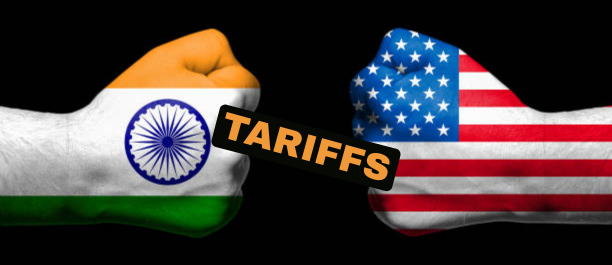
What impact are Donald Trump’s new tariffs on Exports and imports in India through 2025? Learn how US trade policies are affecting Indian exports, imports, and MSMEs. And what is India’s response?
How Trump’s Tariffs Are Disrupting Export and Import in India
Donald Trump’s new tariffs in 2025 have had a major impact on exports and imports in India. The US has increased duties on Indian goods to up to 50%, causing disruption in India’s export-import sector. Sectors like textiles, shrimp, chemicals, and electronics are the most affected. In this blog, we’ll explore how. This policy is affecting exports and imports in India, but industries are suffering the most. And what has been India’s response?

Background: What has changed?
In August 2025, the Trump administration announced reciprocal tariffs. Duties on Indian imports were increased from 25% to 50%. The reason for this was the trade deficit between the US and India with Russia. This decision to continue oil imports is directly affecting the balance of export and import in India, as the US is India’s largest trading partner.
Since then, the profitability of export and import in India has declined for MSMEs and exporters.
Impact on Indian Exports
Price competitiveness weakened.
When TARI increased by 50%, Indian goods became more expensive in the US market, forcing exporters to cut prices or lose orders. This directly affected the cost structure of exports and imports in India .
Decline in export volumes.
According to the report, India’s US exports fell by 20%. Sectors like textiles and seafood suffered the most, slowing the growth rate of exports and imports in India.
Sector Wise Impact:
- Textiles & Garments: US buyers have reduced orders.
- Seafood & Shrimp: Demand is decreasing due to increase in tariff.
- Gems & Jewellery: Orders from the US have started getting cancelled.
- Chemicals & Leather: Profit margins are decreasing due to costly raw materials.
The MSME sector, which relies primarily on exports and imports within India, has put expansion plans on hold. Many small exporters are now exploring new markets.
Impact on Imports and Supply Chains
Trump’s tariff has not only hit exports but also imports indirectly.
- Supply chain disruption – Firms importing raw material solar components from the US are facing higher costs.
- Rupee pressure – Due to reduced export revenue, the rupee has weakened and imports have become expensive.
- Trade diversification – Now companies are sourcing from China, Asian and Europe so that export-import in India remains stable.
Since then, the profitability of export and import in India has declined for MSMEs and exporters.
India's strategic response
India has taken multiple policy steps to keep export and import in India in balance.
- Market diversification- New export markets are being explored in Africa, Latin America and Europe.
- Value addition- Premium and niche products are being developed, which will reduce the impact of tariff.
- Focus is on cost efficiency- logistic and production cost reduction so that export and import in India remain competitive.
- Government supply- Government support. Export subsidy. Low interest loan and trade protection policy has been started.
- Trade Agreement- New FTA (Free trade agreements) are being negotiated with Asian and European countries.
Conclusion
Trump’s tariffs have created short-term challenges for exports and imports in India. But this could be a wakeup call.
Now, Indian exporters will have to focus on innovation, diversification, and digitalization. If India efficiently expands its trade partners and boosts domestic manufacturing, exports and imports in India can become strong again.
FAQ's
1. What are trans-tariffs and how do they affect exports and imports in India?
Trump has imposed import taxes on Indian goods, making Indian products more expensive in the USA. This has created an imbalance in exports and imports in India.
2. Which sector has been affected the most?
The most affected sectors are textiles, shrimp gems, chemicals, and leather, which are major components of India’s exports and imports.
3. What is its effect on small exporters?
Small MSMEs are facing loss of orders and declining profit margins, and the liquidity crisis in export-import in India has also increased for them.
4. Will these tariffs impact India's GDP growth?
In the short term, GDP growth could slow to 0.3 to 0.4%. However, India can recover its export and import growth through diversification.